Why feel, fatigue, and weekly mileage don’t actually answer the question, and what does.
Most triathletes can’t actually answer that question, and not because they aren’t paying attention. The evidence they’re taught to track simply doesn’t answer it. Feel tells you how training felt. Weekly mileage tells you how much you trained. A fast benchmark workout tells you what you did on one day in one set of conditions. None of those things tells you whether the training is actually working.
The short version: training is working when the same physiological cost buys you more output, or when more output costs you the same physiological stress. Everything else is noise.
The signs most triathletes look for, and why they don’t tell you what you think
Feel, fatigue, weekly mileage, and the occasional fast benchmark effort are the signals most triathletes use to judge whether training is working. Each of them is unreliable, and some of them are actively misleading.
How you feel after a workout reflects what just happened to you, not whether the training is producing adaptation. Heavy legs can mean the session was hard, or it can mean conditions were tough, or it can mean residual fatigue from earlier in the week. None of that tells you whether your body is getting fitter underneath the fatigue.
Weekly mileage tells you how much you trained. It says nothing about whether that training was the right training, executed well, in the right sequence. The “more is better” myth, that volume itself is a proxy for fitness, is one of the most stubborn errors in endurance sport. Athletes drop weekly mileage and worry they’re losing fitness, when often they’re cutting the work that was holding them back.
A fast benchmark session, when conditions cooperate, tells you what you did that day. It doesn’t tell you what you can do reliably, in different conditions, under accumulated training load. One workout is a story, not evidence.

Body composition changes do mean something, but they’re slow-moving and easy to misread. Most triathletes hold themselves to weight standards that have little to do with whether their fitness is improving.
The pattern across all of these is the same. Each one tells you something. None of them tells you what you actually need to know.
Outputs without context are noise
Raw numbers, pace, power, mileage, mean something only when you can place them in physiological and environmental context. Without context, the same effort can look like progress or regression depending on conditions you didn’t account for.
Consider a two-hour ride: 100 minutes at Zone 2, 20 minutes at Zone 4. The traditional Training Stress Score (TSS) is 108. Identical. Whether you rode in 59°F and 30% humidity, or 86°F and 60% humidity, TSS gives you the same number.
Normalized Training Stress® (NTS™), part of the FitLogic™ intelligence engine, sees those two rides very differently. Cool conditions: NTS of 79. Hot conditions: NTS of 179. More than double the actual physiological cost, invisible to the traditional metric.
This matters because raw pace, raw power, and raw mileage are all outputs that depend on conditions. EnviroNorm® technology translates outputs into the underlying physiological work, accounting for heat, humidity, altitude, hills, and wind. Without that translation, you’re comparing rides that aren’t comparable, and you’re making decisions based on numbers that lie.
For the full technical breakdown of why TSS misses what it misses, Beyond TSS on FitLogic.tech walks through the comparison case by case.
The real evidence your training is working
Training is working when your body’s physiological response to stress is improving over time. Three signals matter, and most athletes have never had access to any of them.
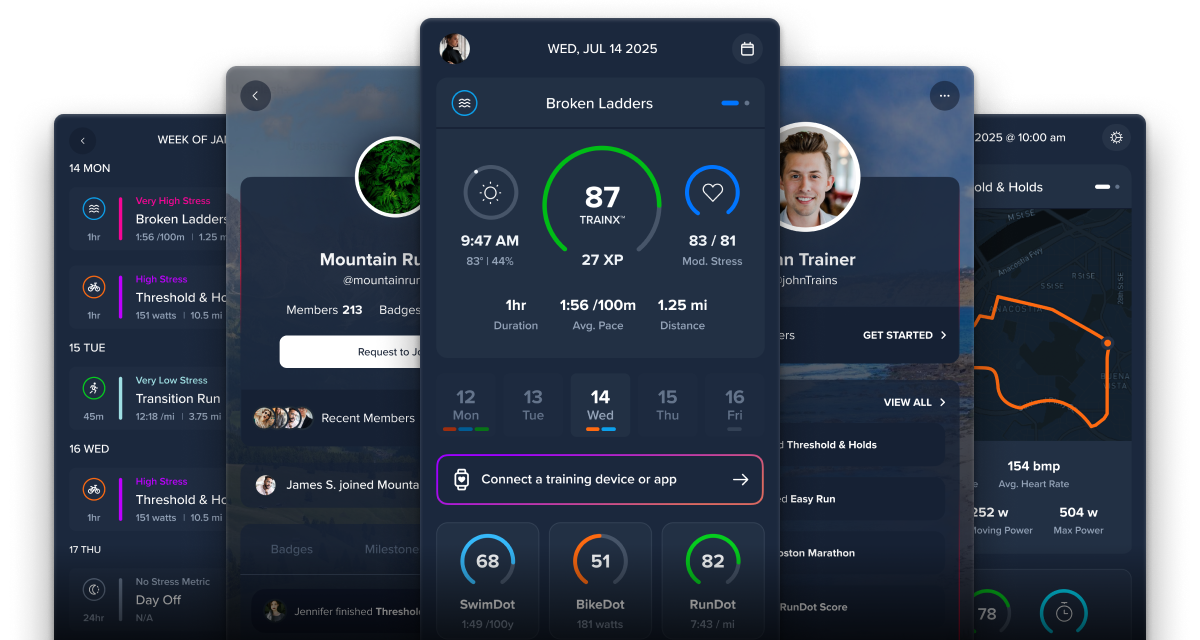
The first is execution quality. Are you actually doing the right training, executed the right way? TrainX® score quantifies that on a 1-to-100 scale, measuring how closely each session matches what the prescription required. Most athletes assume execution quality is binary: did the workout, didn’t do the workout. The truth is more granular. An easy workout done too hard hurts adaptation as much as a hard workout cut short.
The data on this is striking. Across the hundreds of thousands of athletes training with FitLogic, athletes whose TrainX scores averaged 30 points higher improved 3 to 5 times more over a six-month period than athletes who doubled their training volume. Better execution beats more volume, and the gap is not small.
.png?width=1155&height=385&name=TriDot%20Pool%20School%20Swimmer%20(1).png)
The second is normalized training load. Normalized Training Load® (NTL™) measures your weekly workload as the combination of intensity, duration, and frequency your body actually experienced, not just the hours you spent training or the miles you logged. Two athletes can have identical mileage and wildly different NTL. One can be working much harder than the other, or much easier. The hours-and-miles version of training load is a flat shadow of what’s actually happening to you.
This is the metric that lets athletes drop volume without losing fitness. A marathoner who cuts from 50 miles a week to 38 isn’t necessarily training less. With higher quality and the right intensity distribution, their actual workload can stay flat or rise even as their hours fall. NTL makes that visible. Conventional metrics don’t.
The third is recovery. Residual Training Stress™ (RTS™) tracks the lingering physiological stress from previous sessions, and how quickly that stress decays. When training is working, you recover from a given stress load faster, and you can carry more residual stress without your performance degrading. When training isn’t working, the opposite happens. RTS catches both.
The pattern across all three: they measure your body’s response, not your body’s output. The conventional signals (feel, mileage, benchmark workouts) all measure outputs. Real progress lives in response.
Why most athletes can’t actually answer this question
Most athletes can’t answer “is my training working?” because the question requires data and analysis they’ve never had access to. This isn’t an athlete problem. It’s a measurement problem.
Traditional training, even when designed by experienced coaches, leans heavily on accumulation metrics: hours, miles, sessions completed. These were the metrics available historically, and they’re still what most apps track. When the available evidence is what you accumulated, you end up measuring the wrong thing by default.
Training designed from population averages, fixed templates, or training theory faces the same problem in a different form. You can’t verify whether the training is working for you specifically, because the design wasn’t built from your specific response. The question “is this working?” is unanswerable when the input was never about you.
This is what FitLogic was built to solve. The intelligence engine learned from hundreds of thousands of athletes’ actual training and performance outcomes, and it now prescribes training built on your specific physiology, training stress profile, and response patterns. The system measures execution quality through TrainX, contextualized stress through NTS, total load through NTL, and recovery through RTS. When training is working, the data shows it. When it isn’t, FitLogic adjusts your training automatically, before the missed adaptation becomes a missed race.
.jpg?width=3200&height=2134&name=IMG_6789%20(1).jpg)
One specific manifestation of the broader problem is the volume trap. Most athletes equate doing more, more hours, more miles, more sessions, with training harder. It’s not the same thing, and the conflation is one of the most expensive errors in endurance sport. The full case is in this episode of the TriDot® Podcast, but the short version: athletes who optimized execution quality consistently outperformed athletes who simply added volume.
What to do with this
If your training is built on a system that measures execution quality, normalized stress, total load, and recovery, the answer to “is my training working?” is data you can look at, in context, with continuity. Pay attention to those signals over time. They are the evidence.
If you don’t have access to that kind of measurement, the honest answer is that the question hasn’t been answerable. You can rely on conventional signals, knowing they’re rough proxies. Or you can change the inputs and get the question answered properly.
For a deeper look at how training progress actually unfolds across a season, and why “more” isn’t the lever most athletes think it is, the Revisiting the Power-Stamina Paradox episode covers the season-design version of the same idea.
Training works when your body’s response to stress is improving. Not when you feel tired. Not when your weekly mileage is up. Not when one workout went well in cool conditions. Response, measured in context, tracked over time. That’s the evidence, and that’s the answer to the question.
The athletes who can actually answer “is my training working?” aren’t doing more workouts than the ones who can’t. They’re using better evidence. Start your free TriDot trial and see what training built on real measurement looks like.